An article in Wooden Boat Magazine by Christopher Sanders caught my eye. Here was someone trying to determine the wood species used in an old caulking mallet he found, by making copies of it using different wood types.
This challenged me to try my hand at recreating not only the mallet, but other items in the article, with whatever wood and brass tubes I happened to have lying around in my workshop. As the only brass tube I could find (from a drain connector pipe, with the chrome sanded off on the lathe) was about 75% of the original size, that’s the scale I worked in, professionally eyeballing the rest of the proportions off the pictures!
An old oak wardrobe supplied the wood I needed to turn both the removable handle and the business end of the mallet, which is 23 cm (9″) long with a 4 cm (1-1/2″) diameter, as well as fashion the non-bronze chisel copy. For contrast, I used a strip of cocobolo guitar offcut to create and highlight two slots to ‘tune’ the mallet, a bit like the laser slots cut into circular saw blades. To prevent the recycled brass cutoffs from tarnishing, I added a coating of Krylon.

The model of boat planking demonstrates the use of oakum (recycled rope) hammered into the gaps between the wooden hull planks to create a flexible, waterproof caulking seal.

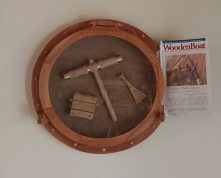
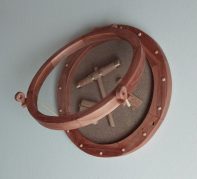
Next step: how to display these nautical tools in context? How about through a porthole?
Here’s the nautically-themed display case (55 cm or 22″ diameter) mounted on the wall with the original article shown for size!
But why stop there? After all, scale modelling is all about perspective!
Many years ago I built a wooden boat in 1:50 scale. Clearly what it now needed was an appropriately sized caulking mallet, shown on board and ready to keep the ship waterproof.
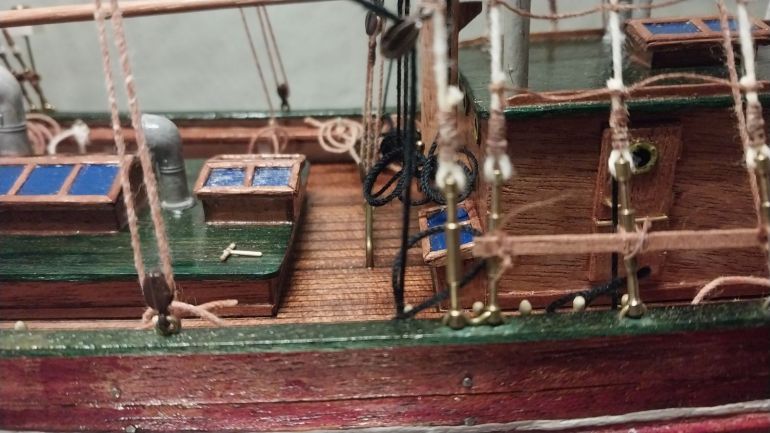
Made from birch, the business end is about 6 mm long (just under 1/4″ long), and about 1 mm diameter (1/24″). Shown just before parting off, the tapered handle is about 7 mm long (just over 1/4″ long).

 NANOTRAY